This piece was originally posted on the GSM-IT project website blog on 11 Feb, 2017
The international day of women and girls in Science celebrates the contribution of women to the field of Science. It also serves as a reminder of the continual challenges that girls and women have to overcome as they enter Science related education and career streams. And so today, on the International day of women and girls in Science, this post highlights women’s participation in Science, Technology Engineering and Mathematics (STEM) related programs at tertiary level (undergraduate studies).
According to the UNESCO Education statistics, in the majority of the countries, less than 30% women graduate from STEM programmes at tertiary level education institutions. The chart below highlights the short list of countries in 2013 where women comprise more than 30% of graduates of STEM programs at tertiary level.
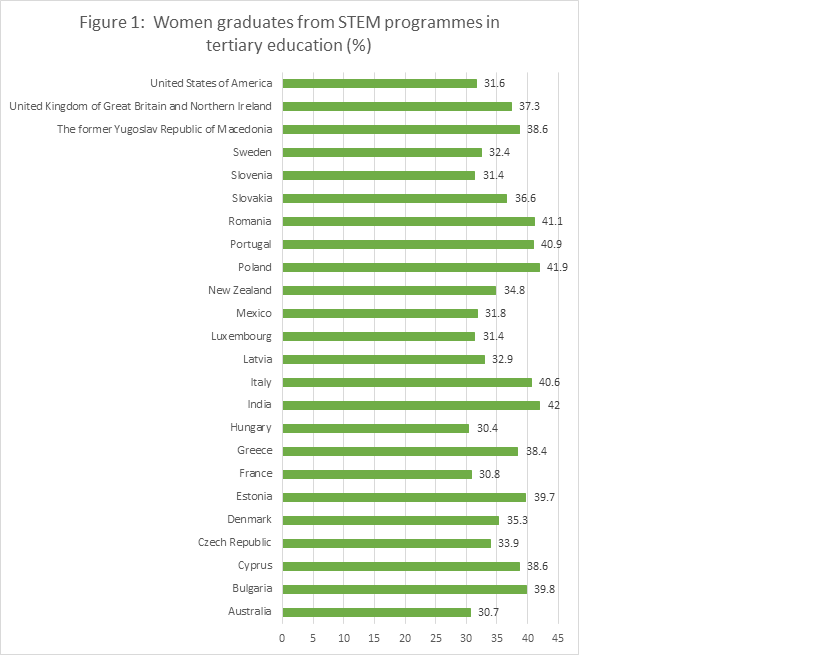
Most Western countries lie on the lower end of the scale – just above the 30% threshold. India ranks amongst the higher percentages of women at 42%, closely trailed by Eastern European States – Poland (41.1%) and Romania (41.1%).
A breakdown of programmes that comprise the broad field of STEM (Engineering, Manufacturing and Construction, Information and communication technologies, and Natural Sciences, Mathematics and Statistics), shows that India outranks other countries with respect to the percentage of women enrolled in these program at tertiary level (s Figure 2).
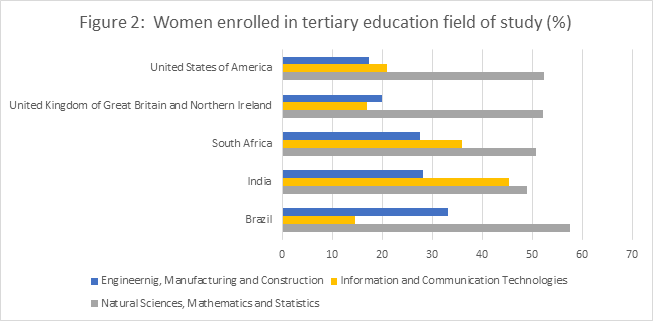
Unsurprisingly, India has the highest percentage of women enrolled in Information and Communication Technologies programs at over 45% (amongst the countries highlighted). Female enrolment in India in Engineering and allied programmes is at 28.1%, second highest after Brazil (33%). However, India is lagging in the percentage women enrolled in Natural sciences, Mathematics and Statistics (48.9%). This pool appears to attract more women in comparison to other fields (across all countries).
Overall, the proportion of women across the three fields of study locate India in an enviable position of having a larger pool of tertiary level educated women in STEM fields, especially when compared to Western countries. This large talent pool translates into a higher percentage of women within the Indian tech sector.
 Gunjan Sondhi
Leave a comment